How to Plan Speed Cushions for Effective Traffic Calming
Traffic calming works best when the device matches the road, the vehicles, and the reason speeds need to be reduced. In a distribution yard, residential access road, campus, or car park, a speed cushion can encourage lower approach speeds while leaving a more deliberate wheel path than a full-width speed hump.
That does not make every cushion suitable for every site. Buyers and contractors should review traffic mix, target speed, drainage, pavement condition, visibility, spacing, and local authority requirements before specifying a layout.
Start with the operating problem
Record where speeding occurs, current speeds, vehicle types, pedestrian crossings, junctions, gates, loading areas, noise-sensitive buildings, and any history of near misses. A cushion placed too close to a bend or hidden by parked vehicles may surprise drivers instead of calming them progressively.
Decide whether the objective is to slow vehicles at one conflict point or to manage speed along an entire route. A single device may protect a gate or crossing; a corridor normally needs coordinated spacing, signs, markings, lighting, and enforcement.
Width, height, and approach profile matter
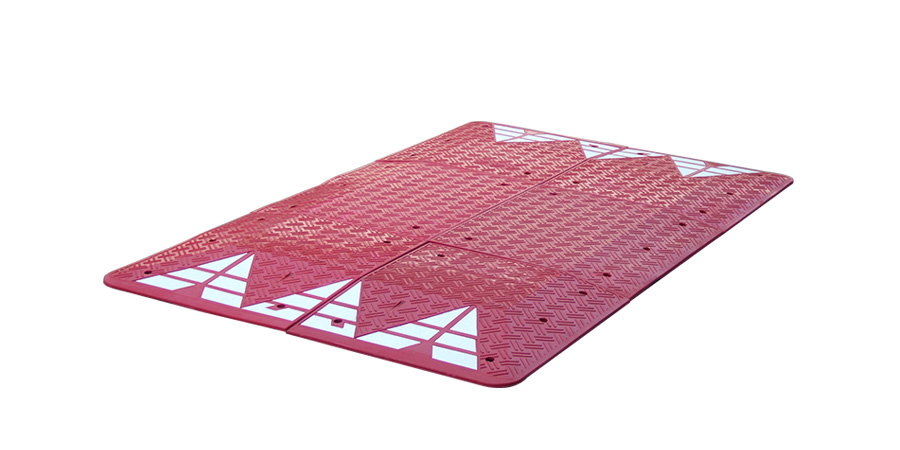
Cushion width influences which vehicles pass over the raised surface and how drivers position their wheels. Height and ramp profile affect the speed response and ride quality. EastSea’s DH-SP-4 speed cushion is listed in 2,000 and 3,000 mm lengths, both 1,800 mm wide; the listed heights are 75 mm and 65 mm respectively.
Those dimensions are inputs, not a universal prescription. Confirm the vehicle fleet—including buses, emergency vehicles, forklifts, low-clearance cars, motorcycles, and bicycles—and obtain approval for the intended geometry under applicable local rules.
Compare construction and modular formats
Material and sectional design affect handling, anchoring, replacement, surface grip, and lifecycle cost. A modular rubber system can simplify transport and allow individual damaged sections to be replaced. The UK Rubber Speed Cushion is listed at 1,800 mm wide and 63 mm high, with 2,000 and 3,000 mm configurations.
Plan visibility and the surrounding road space
Drivers need enough sight distance to recognise the device and reduce speed smoothly. Coordinate the cushion with advance signs, pavement markings, street lighting, kerbs, crossings, parking restrictions, and access points. Check that vehicles cannot simply bypass it through a shoulder, cycle area, or opposing lane.
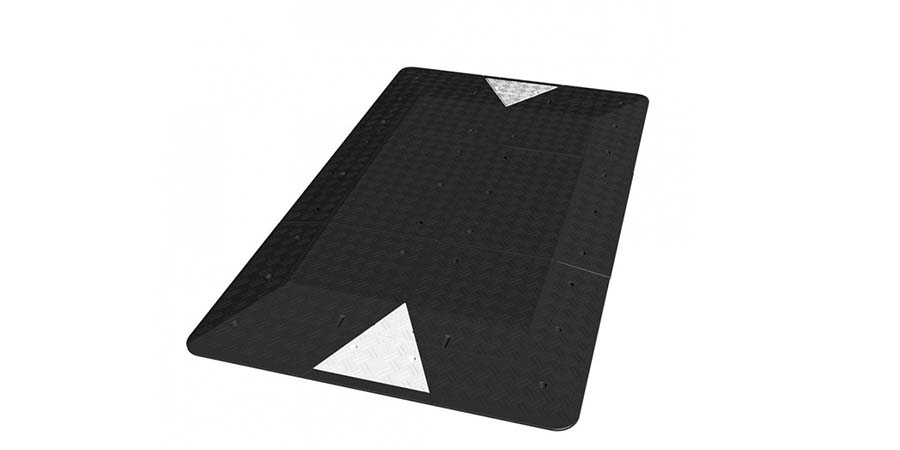
Colour contrast and reflective areas can improve recognition, but they do not replace correct placement or maintained signs and markings. The Belgium Speed Cushion is listed at 1,800 mm wide and 65 mm high, in 2,000 and 3,000 mm lengths.
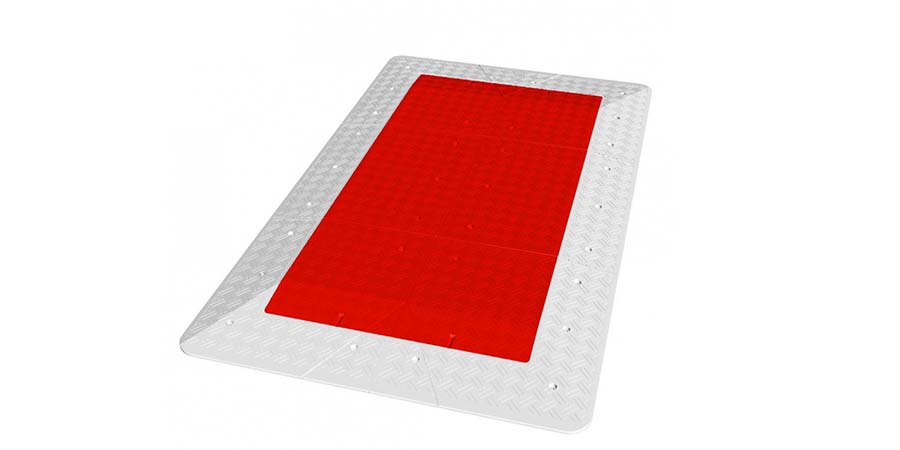
Installation quality determines performance
Survey the pavement for cracks, weak edges, utility covers, slopes, and drainage paths. Set out the modules accurately, use the specified anchors for the substrate, and avoid trapping water or blocking runoff. After installation, confirm alignment, fixing security, edge transitions, signs, and markings before opening the route.
Inspect routinely and after heavy impacts or road works. Look for loose fixings, lifted edges, worn surfaces, missing reflectors, pavement breakup, standing water, and evidence of drivers taking an unsafe avoidance path. Repair defects promptly and review the layout if traffic patterns change.
Prepare a useful quotation request
- Site type, road width, photographs, and layout drawing
- Measured traffic speed and desired operating outcome
- Vehicle mix, axle widths, ground clearance, and daily volume
- Required cushion length, width, height, colour, and quantity
- Pavement material, drainage, anchors, signs, and installation scope
- Applicable local approval, testing, or documentation requirements
Explore EastSea’s speed cushion range, or contact EastSea with your road layout and vehicle information for a project-specific discussion.